NOVO Sivan Rubinstein, review
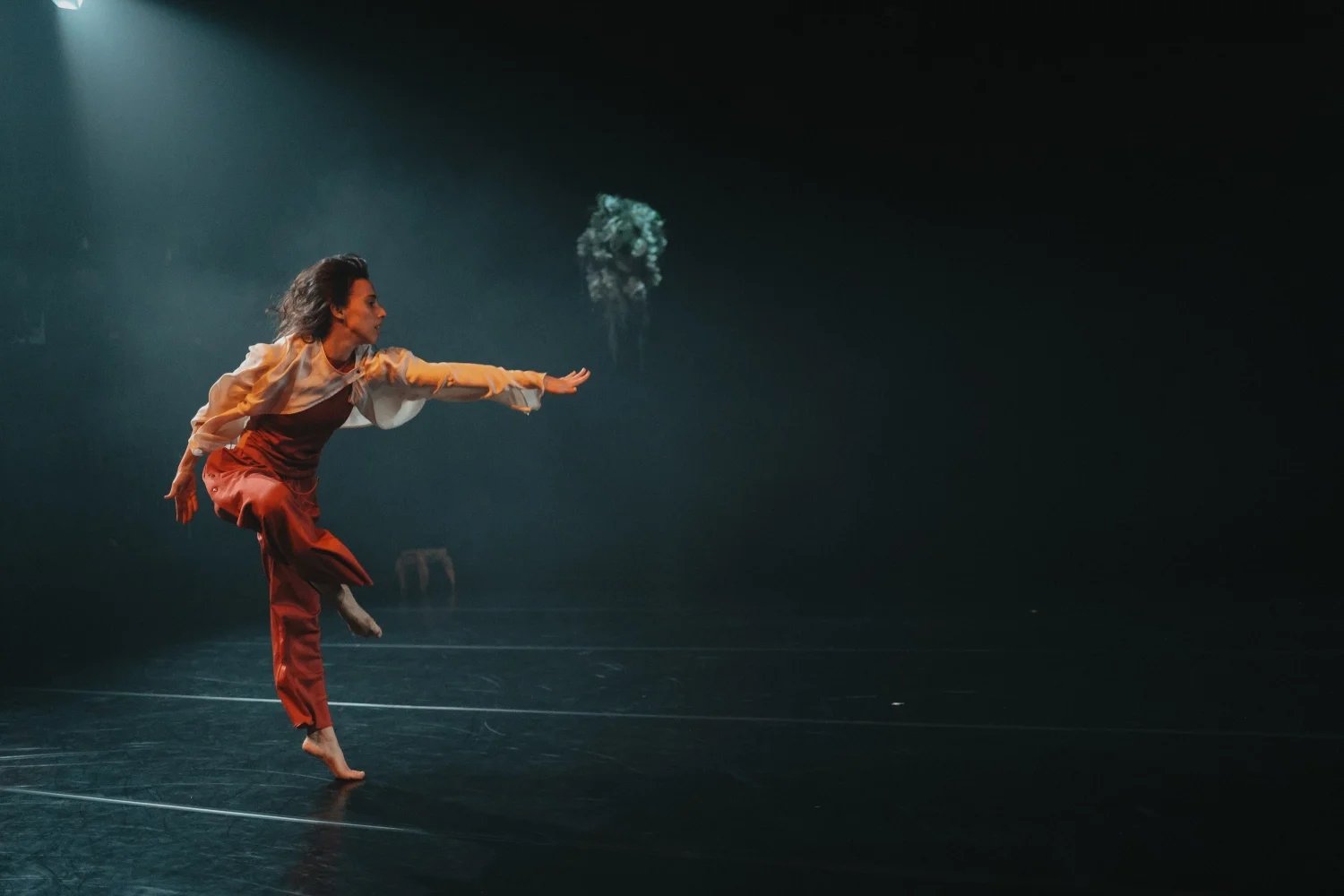
NOVO Premier Photo by Lior Shlik (c)
Becoming a mother is one of the most impactful experiences in a woman’s life, involving a profound shift in identity. The transformation involves, but is not limited to, a revised sense of the reality of value; biological change; relationship realignment and prioritisation; and, for most, the greatest challenge to some earlier vision of professional career. The change leaves many gasping in wordless confusion. Emotions are amplified, clashing, confusing, and uncontrollable. Within this storm the ship of Theseus that is you tries to find balance in a world upturned. Then suddenly,
Clap.
The storm is broken with a sound. And then again.
Clap. Clap.
Around you, chatting heads turn toward the sound. The crowd, now silent, is paying attention.
Clap. Clap. Clap.
Somehow, this crowd is now a community. Pulled into the orbit of the slim, tiny, but powerful figure clapping slowly, steadily, confidently, soothingly, in the middle. We clap too. Acknowledging us with eye contact, the figure weaves between us and then leads us from this place into the room where, in tandem with a tender solo performance from the cello, she will express an emotion approximated in The Dictionary of Obscure Sorrows: “hubilance”.
Sivan Rubinstein’s NOVO, performed at The Place, upturns everything I ever knew about dance performance. It begins by reversing the clap from end to start. Over the hour we spend together, (and this is how the dance feels, like a togetherness), Sivan’s body moves as if through a liquid atmosphere of light and music. NOVO is a solo dance work rooted in pregnancy, birth, and maternal transformation, but it is also something broader: an interdisciplinary performance about embodiment, separation, dependence, rupture and return.
A vessel navigating the bliss and trauma of pregnancy, the euphoria and grief of birth, Sivan represents the rupture in the oneness between mother and baby, and the bewildering result of two new persons: mother and child. This dance, this one, is about her second pregnancy, and it occurs to me that this articulation of the uniqueness of motherhood, the distinction of experience from child to child, is new to me. I am sitting with my second daughter, and I find myself touching her arm lightly.
What makes NOVO so powerful is that it does not merely illustrate motherhood; it choreographs the instability of becoming a mother. Much of the movement is small before it is expansive: hands gathering and releasing, the torso folding and opening, weight dropping through the feet before the body seems to be pulled upwards again. There are moments of stillness that feel less like pauses than like pressure building inside the body. The movement seems at times to come from breath, at times from memory, and at times from some deeper animal knowledge of what the body has endured.
The staging is minimal: diaphanous fabrics that amplify the shadows and movement, foliage connecting to the roots of Sivan’s feet. Liran Donin on the double bass with his perfectly appointed score, Xenia Aidonopoulou’s dramaturgy, Zoé Ritchie’s lighting, Alina Dheere’s botanical set design and Zi Kim’s costume design all support the sense that the body is being held between fragility, ritual and transformation. There is a clear stylistic line here between NOVO and Sivan’s earlier production MAPS, about movement without borders, and, notably, a clear methodological approach. MAPS, which I was introduced to through philosopher Dr Sarah Fine of Cambridge, was based on serious research and deep collaboration. Similarly, NOVO has maintained that collaboration with Dr Sarah Fine and broadened it to include Dr Margarida Cardoso Moreira of the Francis Crick Institute. These are not the only collaborations that have fed the performance and been fed by it, and that shared generative process is evident in the choreographic style. The day after, I found myself reading up on the philosophy of pregnancy from Professor Elselijn Kingma. In other words, it’s dance that get’s you thinking.
Despite the primitive and essential fact of pregnancy and birth, one may still struggle to find reflections of what it is like to undergo it in art. NOVO joins some notable exceptions, from traditional painters like Mary Cassatt to the spoken word poet, Hollie McNish, performing her mantra “Megatron”. Even John Koenig’s noble attempt to offer us a word, “hubilance”, risks over-romanticising. What of the primal scream? The visceral, bloody, screaming, tortuous pleasures and pains for the mother? Well, here it is in all its beauty.
I first saw NOVO at an earlier stage of development, and even then I left the performance choked — because, of course, I am British and I can’t just let go in the room — by the electric shock that watching this can be. The kaleidoscope of thoughts that it provoked. What it is to be a mother. The sustenance that art can offer to counter the fragility of the body and the mind during these vulnerable phases. The sense of longing one always has for the part of oneself that has left the womb. How we disappear in these phases, only to reappear in a form that can take us by surprise.
Although NOVO is grounded in pregnancy and birth, it is not only for those who have given birth. It is for anyone interested in how bodies carry change before language can catch up. When the lights came on, my daughter said, “Oh, I’ve never felt anything like that.”
Take your daughters, and watch it with them.
NOVO
Sivan Rubinstein
Performed at
The Place
2–3 June 2026
17 Duke’s Road
LondonWC1H 9PY
(020) 7121 1100
Sivan Rubinstein: Choreographer
Liran Donin: Double Bass, Composer
Xenia Aidonopoulou: Dramaturg
Zoé Ritchie: Lighting Designer and Production Manager
Alina Dheere: Botanical Set Design
Zi Kim: Costume Designer
Lou Moria: Research & Development Collaborator
Masako Matsushita: Research & Development Collaborator
Lydia Walker: Understudy
Treacle Holasz: Producer
Zoë Grain: Assistant Producer
Thea Carter: Assistant Producer
Upright Fools: Marketing & Digital Content Support
Siân Gilling: Social Media Coordinator
Ricardo Reverón Blanco: Creative Consultant and Exhibition Co-curator
Yasiel Campos: Exhibition Designer
Maya Cohen: Graphic Designer
Jurga Ramonaite: Photographer